As Obon draws near, there is a quiet moment when the heart turns toward home.
“This year, I really must go back.” “I want to visit the family grave.” “I want to put my hands together properly for that person.” And yet — work, distance, health, family circumstances — there are years when none of it goes as we hoped. Many people feel a quiet pang of regret at not being able to return.
Yet Obon, at its heart, is a time to turn one's mind toward those who have passed. More than the place where we stand, what matters most is how fully we direct our heart toward our ancestors and loved ones.
We welcome the departed and our ancestors home, prepare offerings, give thanks, dedicate the merit of our prayer, and quietly see them off again. Obon is the time when each of these gestures becomes a layer of prayer.
The Byodoji Online Obon Memorial Service holds that prayer on your behalf — gathered as a service before the Spirit Altar of our temple's inner hall — for those who cannot make the journey home or visit the family grave. From your home, while traveling, or from overseas, you may join your heart to the same service.
This Obon, let our temple welcome your “okaerinasai” — your “welcome home.”
2026 Services
Two services, in July and in August
The timing of Obon varies by region and by family. In Tokyo, Yokohama and other metropolitan areas, July Obon is observed; in Shikoku, Kansai and most other parts of Japan, the month-later August Obon is more common. Neither is more correct than the other. Please choose whichever fits your family's calendar, your hometown's tradition, or simply the time when it is easiest for your family to put their hands together.
Following the urban calendar of Tokyo, Yokohama and other metropolitan areas
July Obon Memorial Service
7.10 ― 7.16 (Fri → Thu)
Held in keeping with the July Obon observed in Kanto and other urban regions, in memory of your ancestors and departed loved ones.
Throughout Obon, we serve nightly from 8 PM at the inner hall
Throughout the July and August Obon periods, the priests of Byodoji conduct a memorial service each evening from 8:00 PM before the Spirit Altar of the temple's inner hall. The names of the ancestors and loved ones you entrust to us are read aloud, and the merit of the service is dedicated to them.
Here is how the service unfolds, and how you might join in. If you can be present at 8:00 PM, do; if not, simply put your hands together quietly at a time that suits you.
Throughout Obon, from 8:00 PM each evening, we hold a memorial service before the Spirit Altar set in the temple's inner hall, dedicated to your ancestors and departed loved ones.
We serve at the same hour each evening, throughout both the July and August Obon periods.
The names, posthumous Buddhist names and prayer intentions you have entrusted to us are read aloud by a priest.
Through nightly service from 20:00, we hold this memorial carefully across the entire period.
Recitation & Dedication
We dedicate the merit of the service to those who have passed
Through sutra recitation and dedication, we prepare the offerings, welcome the departed, and convey our gratitude — giving form to the spirit of Obon.
Stupas (sotoba) and memorial tablets (ihai), if you order them, are enshrined on the Spirit Altar for the duration of the service.
Whether you join us from afar, from overseas or from your own home, you may put your hands together at the very same hour.
Every day, throughout the period
From welcoming Obon to sending Obon — held each evening
Rather than a single observance, we hold service each evening across the Obon period — welcoming the departed, presenting offerings, dedicating the merit, and seeing them off again. We hold the entire flow with care.
July Obon runs July 10 – 16; August Obon runs August 10 – 16.
After the services conclude, certificates of dedication and any items requested are sent to you in due course.
What You Receive
Even in years when you cannot return, the temple holds Obon for you
Join the 8 PM service from anywhere
From your computer or smartphone at home, you may join the Obon memorial held before the Spirit Altar of our temple's inner hall. Whether returning home is difficult, or going out feels uneasy, you may put your hands together from wherever you are.
Names read aloud by a priest
The names, posthumous Buddhist names and prayer intentions you entrust to us are read aloud by a priest during the service, and the merit is dedicated to your ancestors and departed loved ones.
Together, with family
Family members living far apart may join the same livestream, the same service, with hearts together. Even in years when gathering in person is hard, you can share a single hour of prayer.
From welcoming through sending — without break
Throughout Obon, at 8:00 PM each evening, we hold the memorial before the Spirit Altar of the inner hall, from welcoming Obon all the way through sending Obon.
At your own pace, on your own terms
Whether your reason is work, distance, illness, caregiving, raising children, or living overseas — even when attendance is difficult, you may continue this practice in whatever form is possible for you now.
Open to any tradition
What we hold dear is the wish itself: to think of the departed, to give thanks to your ancestors, and to put your hands together. If you have a family temple (bodaiji), please honor its services and your family's customs first; in years when returning home or visiting graves is difficult, please make use of our online memorial as a complement.
Source
Obon grew from the meeting of two hearts: offering and welcoming
Behind Obon stands the story of the venerable Maudgalyāyana, told in the Ullambana Sutra. Learning that his late mother was suffering, Maudgalyāyana asked the Buddha for a way to deliver her. The Buddha taught him to offer alms to the assembled monks at the close of the rains retreat, and to dedicate that merit to his mother.
Make the offering — and dedicate its merit to those who have passed.
—— This is the Buddhist practice at the heart of the Ullambana memorial.
At the same time, Obon in Japan grew into a custom of welcoming our ancestors and departed loved ones into the home, hosting them with offerings, and seeing them off at the close. The welcoming fire, the Bon lantern, the spirit horse and ox, the offerings, the sending fire — each carries the heart of receiving the departed as honored guests.
Obon is what grew when the Buddhist teaching of “offering and dedication” met Japan's long-cherished spirit of “welcoming, hosting and seeing off ancestral spirits.” At Byodoji, our Obon Memorial Service follows this same flow with care.
01
To make offerings, and dedicate the merit
The Ullambana Sutra recounts how the venerable Maudgalyāyana made offerings to the monastic community and dedicated the resulting merit to his late mother — and how she was thereby freed from her suffering. At the heart of Obon lies this Buddhist practice: not merely to remember the departed, but to act with goodness and turn the merit toward them.
02
The fifteenth day of the seventh month
The fifteenth of the seventh month was, in Buddhism, the day on which monks reflected upon their practice at the end of the rains retreat. In China, it also fell upon the Mid-Origin festival, when ancestral spirits were honored. The day of offering and the day of welcoming the ancestors flowed together, and from this confluence the Ullambana memorial took shape.
03
“Obon,” shaped within Japan
In Japan, the Ullambana memorial has been observed since ancient times, gradually weaving itself into local beliefs about ancestral spirits and household customs. To welcome the departed, present offerings, gather as a family, and at last see them off with the sending fire — this whole sequence has taken root in everyday life as “Obon.”
Memorial
Online, yet held with the same care as a service in our inner hall
Reading of names
The names, posthumous Buddhist names and prayer intentions you entrust to us are read aloud at 8:00 PM each evening of the period, before the Spirit Altar of our temple's inner hall. Even from afar, you may put your hands together at the same hour.
Enshrinement on the Spirit Altar
If you request a stupa (sotoba) or memorial tablet (ihai), it is enshrined on the Spirit Altar set in our inner hall, and held there for the duration of Obon. We treasure the full flow — welcoming, holding, and seeing off.
Sent after the service
Certificates of dedication and any requested items are sent to you in due course after the services conclude. When they reach you, please enshrine them at your home altar or in another fitting place — receiving them as an occasion to put your hands together from time to time.
Customs
The heart held in each sign of Obon
Mukaebi · Okuribi (welcoming and sending fires)
The mukaebi, or welcoming fire, is a light kindled to receive ancestors and departed loved ones. “Please come home — without losing your way.” That wish is entrusted to the small flame.
The okuribi, or sending fire, is a light kindled to see them back to the world of the buddhas. “Thank you for returning to us this year as well.” With this gratitude, we see them off.
Spirit horse · Spirit ox
The cucumber horse carries the wish that the departed return to us swiftly. The eggplant ox carries the wish that they take their time on the journey back, and the reluctance to part. In these humble offerings, the heart that awaits a reunion and the heart that grieves at parting are quietly placed side by side.
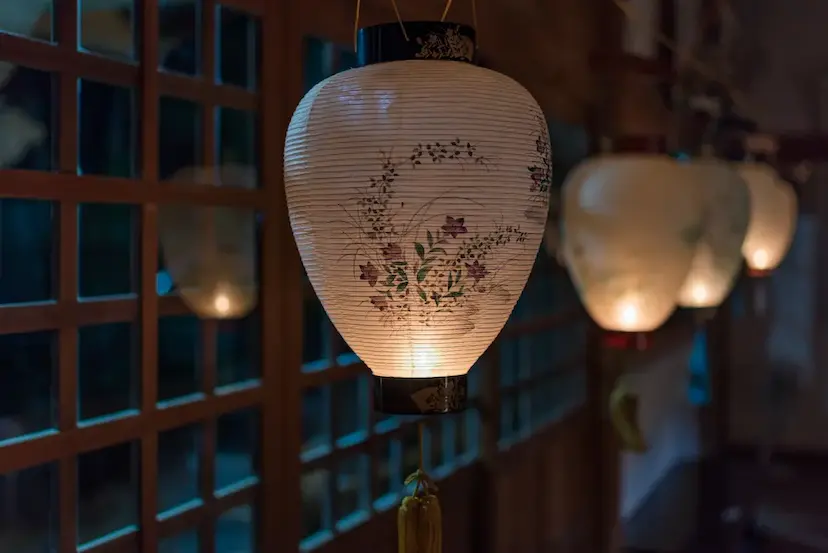
Bon lantern
The Bon lantern is a marker placed to welcome ancestors and departed loved ones home. For a first Obon (shinbon or hatsubon) after a passing, a white lantern may be lit — a family's prayer that the departed, returning for the very first time, may find their way without difficulty.
Offerings
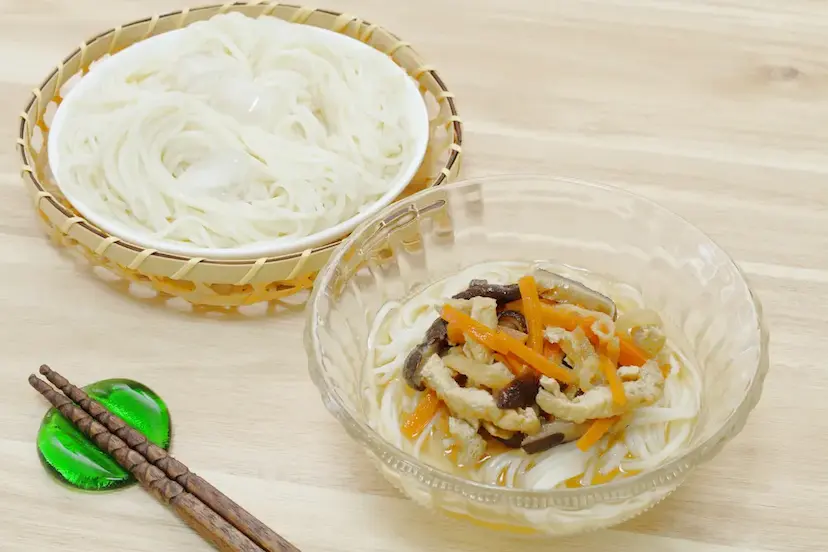
For Obon, families set out seasonal fruit, somen noodles, vegetarian dishes, and the things the departed loved. What matters is not so much the splendor of the offerings as the heart that places them with care — and in that very gesture, the meaning of an offering is carried.
“This was your favorite, wasn't it?” “Here it is for you again this year.” Remembering, and quietly speaking to the departed, is itself a form of memorial. To remember through food is, in its own way, a precious form of welcoming at Obon.
Apply
Please apply according to your family's calendar
Whether you choose July or August, the heart you bring to your ancestors is no different. Please select the time that fits your hometown, your family temple's calendar, or simply when your family can most easily put their hands together.